Introduction
What is slaude?
A Slack-native Claude Code runtime. One Slack thread is one persistent session, with a persona you write, an approval gate, and skills that grow.
slaude runs Claude Code as a teammate inside a Slack workspace. One Slack thread
maps to one persistent session. The SDK resume: id keeps that conversation
across idle restarts, so a thread you left yesterday continues today.
It is Slack-only by design, and headless: run it on a server, and point Slack at it over Socket Mode. One container runs one persona. Add an agent by adding a deployment.
git clone https://github.com/barockok/slaude.git
cd slaude
bun install
bun run manifest > manifest.json   # paste into api.slack.com/apps → From manifest
cp .env.example ~/.slaude/.env     # fill SLACK_BOT_TOKEN, SLACK_APP_TOKEN, ANTHROPIC_API_KEY
bun run dev                        # or: docker compose up -d --build
Where to go next#
Why slaude#
| Feature | What it means |
|---|---|
| One thread, one session | Each Slack thread maps to a persistent Claude session. resume: keeps the history across idle restarts, controlled by SLAUDE_IDLE_MINUTES (15 by default). |
| Two-layer persona | A hardcoded runtime baseline covers Slack output, approval discipline, and engagement. Your ~/.slaude/SOUL.md covers name, role, voice, manager, mandate, and approvers. You author only the second layer. |
| Slack output through MCP | The agent never streams raw text to Slack. Every reply goes through mcp__slaude_slack__reply, edit, upload, or request_approval. Markdown converts to Slack mrkdwn, and a table becomes a monospace block or a definition list. |
| Manager-style approvals | The agent calls request_approval(summary) before it mutates anything. The approver allowlist comes from SOUL.md, and keyword matching decides who may approve what. The agent never chooses a user id. |
| Engagement model | An @mention engages a thread. An @mention of somebody else disengages it. Plain replies in an engaged thread are handled, and DMs are always engaged. /1on1 locks a thread to you and the manager. |
| Skills that evolve | ~/.slaude/skills/<slug>/SKILL.md reloads every turn. The agent writes its own skills with mcp__slaude_skills__write_skill, and sync_manifest pushes them to git, so they survive a redeploy. |
| Knowledge bases | Plain markdown wikis, in the style of Karpathy's LLM wiki. The agent navigates with Read, Grep, and Glob. There are no embeddings and no chunking. A writable KB turns raw/ into wiki/ through /ingest. |
| Simulation gateway | Check engagement, channel mode, and the approval buttons with no Slack workspace. It runs the same createGateway against an in-memory transport, and bun sim run gates CI. |
Architecture at a glance#
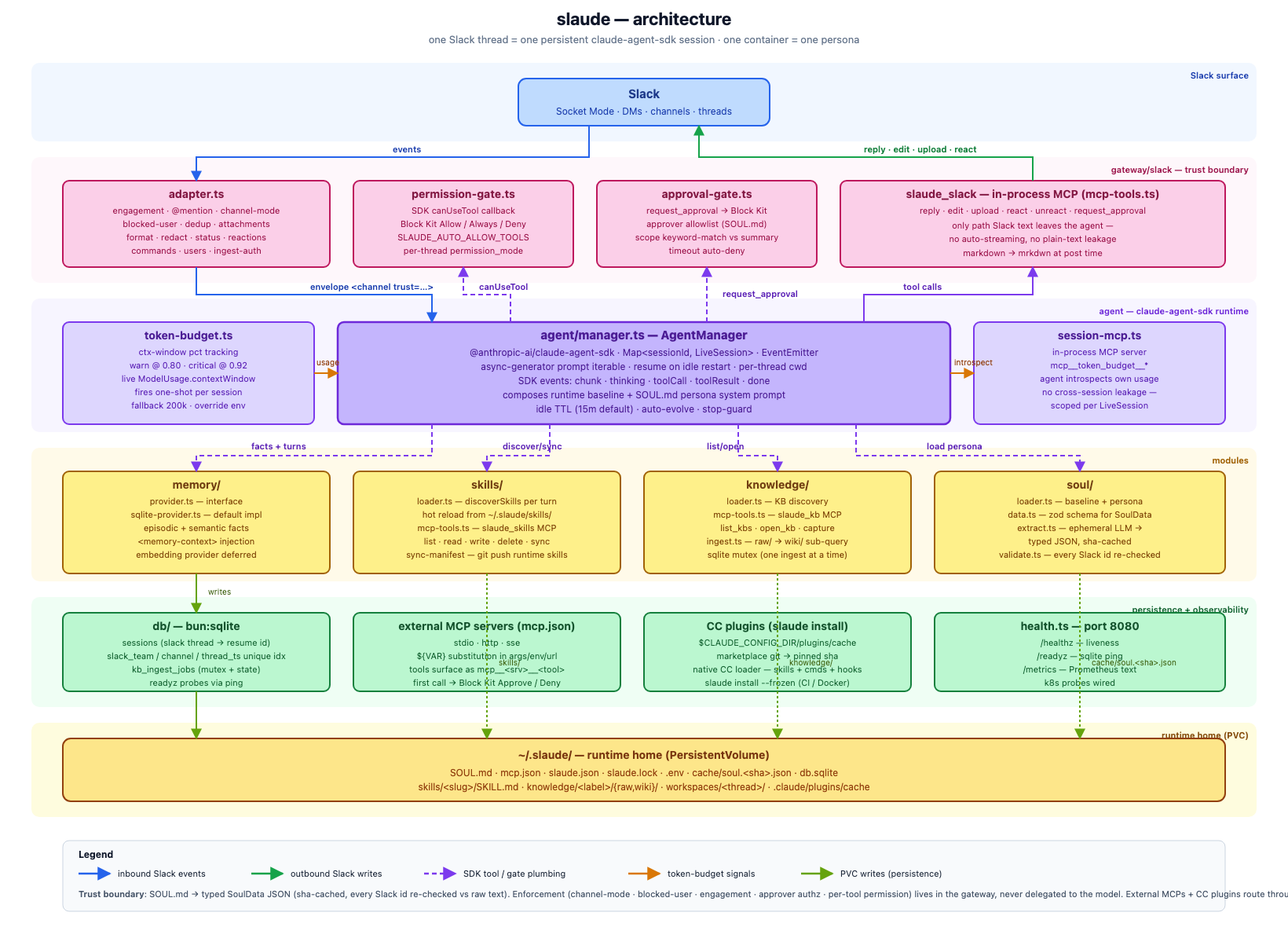
Five layers: the Slack surface, the gateway trust boundary, the agent on
claude-agent-sdk, the modules, and persistence with observability, all on top
of the runtime home. The gateway makes every security decision. The model
supplies only text.
Open the full architecture. The diagram source is
docs/internal/architecture.html,
and its header explains how to regenerate the PNG with headless Chrome.
Trust boundary#
The model extracts SOUL.md into typed JSON. Every Slack id it returns is
checked against the raw SOUL.md text before any gate uses it. Channel mode,
blocked users, engagement, approver authorization, and per-tool permission all
run deterministically in the gateway, never in the model.
A jailbroken persona can mislead an approver. It cannot redirect an approval or approve its own work. The full enforcement chain is in Architecture.